

Breakthrough Guided Cherenkov Method Reads Electron Vortices as Structured Radiation
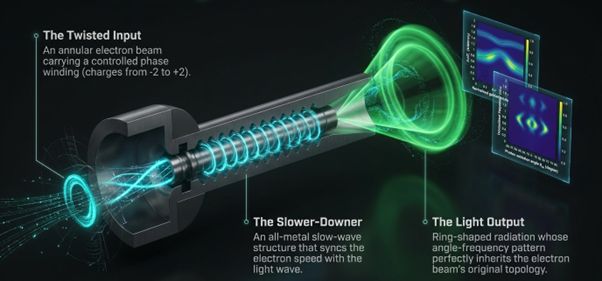
Guided Cherenkov topology transfer. An annular vortex-electron beam excites an all-metal slow-wave structure, producing ring-shaped radiation whose angle-frequency pattern and field structure reflect the electron beam’s topology

Polarization-skyrmion reconstruction from full-Stokes measurements. The colors and arrows describe the spatial polarization field, while the cumulative skyrmion number approaches a plateau near one within the fixed analysis radius.
The project brought together researchers from multiple institutions with expertise in electron-beam control, slow-wave structures, electromagnetic simulation, optical diagnostics, and topological analysis. Sun-Hong Min conceived the study and designed the
An all-metal slow-wave structure transfers electron topology into orbital angular momentum and polarization skyrmions for simultaneous readout
CHENGDU , SICHUAN , CHINA, September 10, 2026 /EINPresswire.com/ -- Researchers have demonstrated a direct bridge between vortex electrons and structured electromagnetic radiation. By sending an annular electron beam through an all-metal slow-wave structure, they transferred the electron beam's helical topology into measurable orbital angular momentum and a polarization-skyrmion texture. Multiple optical diagnostics confirmed the mapping, while repeated single-shot measurements showed reproducibility. The proof-of-principle platform could support structured-radiation sources and noninvasive diagnosis of vortex-electron states across future spectral bands and frequencies.How Twisted Electrons Transfer Their Information to Radiation?
Light is usually described by its color, brightness, and polarization, but it can also carry a twist. In a beam with orbital angular momentum, the wavefront winds like a corkscrew around the direction of travel. This twist is labeled by an integer and can act as an additional information channel. Electrons can be prepared in a similar vortex state: their quantum wave has a helical phase, even though the particles still move forward as a beam. Until now, however, directly transferring this electron-borne topology into radiation while reading both the phase twist and the polarization pattern has remained difficult.
The research began from a simple question: can the topology of a vortex-electron beam be converted into a form of electromagnetic radiation that can be measured without intercepting the electron state itself? The team used guided Cherenkov emission, a process related to the familiar blue glow produced when a charged particle moves faster than light can propagate through a medium. In this experiment, the relevant wave is slowed inside an all-metal slow-wave structure. When an annular relativistic electron beam passes through the structure, it excites a guided electromagnetic mode and produces ring-shaped radiation. Because the input electrons carry a controlled phase winding, the emitted field can inherit that winding. The study was published in Opto-Electronic Advances on August 17, 2026.
To test the transfer, the researchers prepared electron states with charges from -2 to +2 and examined the radiation in the 15–25 GHz microwave and millimeter-wave range. They used fork-shaped interference patterns to identify the sign and size of the radiation's twist, reconstructed the complex field to separate its orbital-angular-momentum components, and used a q-plate measurement as an independent check of spin-orbit behavior. They then performed full-Stokes polarimetry, which measures the complete polarization state at every point in the beam. This revealed a polarization-skyrmion texture: a smoothly varying, topologically organized pattern whose reconstructed skyrmion number approached one within a fixed analysis region.
The measurements showed that the intensity-weighted mean orbital angular momentum followed the prepared electron charge, while the remaining spread was quantified rather than hidden. The same analysis applied to 125 accepted single-shot measurements stayed centered near the expected mapping. The angle-frequency pattern also followed the guided Cherenkov selection rules. Together, these results establish a reproducible electron-to-field topology-transfer interface rather than a single illustrative image.
2. Why the Topology-Transfer Platform Matters
Professor Sang Yoon Park's team at Kyonggi University, working with collaborators from research institutes, universities, and industry, presents the platform as more than a new radiation source. Its central value is that it links a prepared electron state to two different properties of the emitted field at once. One is scalar phase topology, measured through orbital angular momentum. The other is vectorial polarization topology, measured through the Stokes field and its skyrmion number. Reading these two layers together provides a richer description than intensity measurements alone.
The approach is especially relevant to structured-light photonics, free-electron radiation, beam diagnostics, precision sensing, and future communication systems that use spatial modes. Orbital-angular-momentum channels can expand the ways electromagnetic waves are encoded, while polarization textures can offer additional control over how fields interact with matter and devices. The present experiment does not yet represent a ready-to-use communication product, but it provides a practical route for generating and verifying structured radiation directly from an electron source. It also suggests a noninvasive diagnostic: instead of destroying or directly sampling a vortex-electron state, researchers may infer its topology from the radiation it produces.
The work is important because the conversion mechanism is governed by guided dispersion and phase matching rather than by one fixed frequency. The demonstrated system operates in the 15–25 GHz range, with quantitative topology analysis performed in a controlled 19–21 GHz window, but the physical principle can guide designs at other bands. This makes the study a proof of principle for platforms extending toward terahertz and, with suitable materials and fabrication, optical frequencies. The reported beam-to-structured-radiation efficiency of about 6 percent and dominant-channel OAM efficiency of about 1.8 percent also provide a quantitative starting point for optimization rather than an unmeasured promise.
Future development will focus on higher modal purity, better electron-beam coherence, improved beam-structure alignment, reduced material loss, and more precise fabrication. Band-specific slow-wave structures will be needed as the operating frequency rises. If those challenges are addressed, the platform could support compact structured-radiation sources, advanced characterization of electron beams, and new experiments that connect electron physics with topological photonics. Its broader significance lies in showing that topology can be transferred, measured, and cross-validated across two very different physical carriers: electrons and electromagnetic waves.
***
Reference
Title of original paper: Topology transfer from vortex electrons to structured radiation via guided Cherenkov emission: orbital angular momentum and polarization skyrmions
Journal: Opto-Electronic Advances
DOI: 10.29026/oea.2026.260107
Funding information:
This work was supported by the National Research Foundation of Korea (NRF) grant funded by the Korea government (MSIT) (Nos. RS-2024-00335957, RS-2025-25443500, RS-2024-00443040, RS-2023-00236794, RS-2025-00559988, RS-2026-25545406, and RS-2026-25496425). This study was also supported by a grant of the Korea Institute of Radiological and Medical Sciences (KIRAMS), funded by the Ministry of Science and ICT (MSIT), Republic of Korea (Grant No. 50462-2026).
Siyi Ma
Institute of Optics and Electronics
oej_publishing@ioe.ac.cn
Legal Disclaimer:
EIN Presswire provides this news content "as is" without warranty of any kind. We do not accept any responsibility or liability for the accuracy, content, images, videos, licenses, completeness, legality, or reliability of the information contained in this article. If you have any complaints or copyright issues related to this article, kindly contact the author above.
