

Halide electrolytes power the next generation of batteries
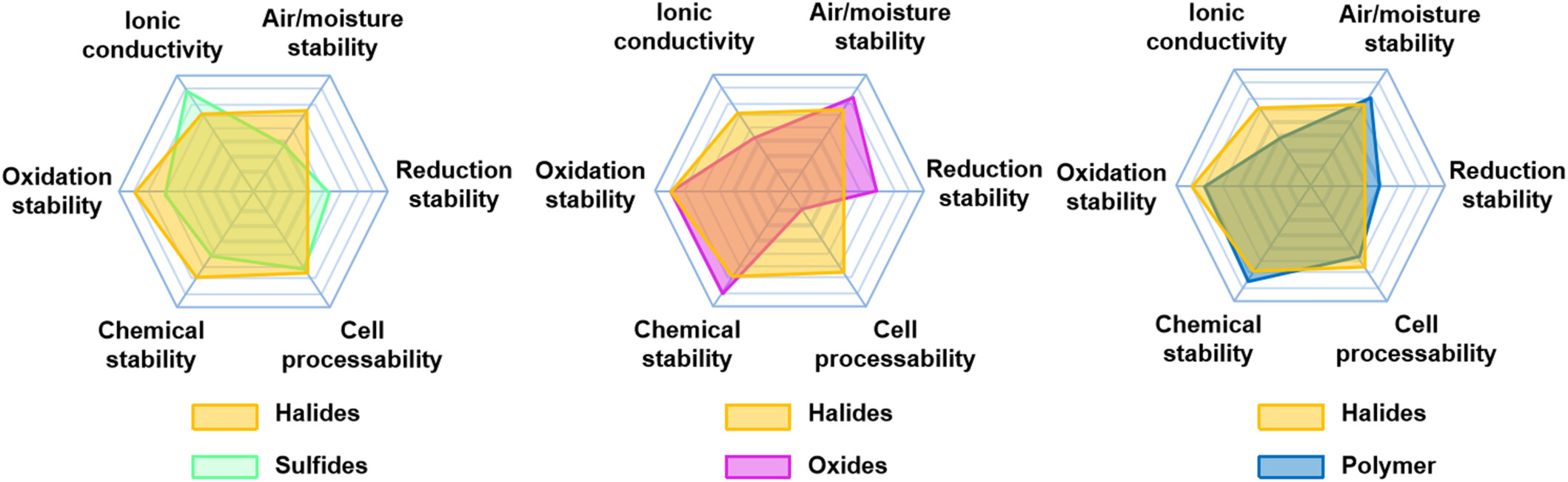
Performance comparison of HSSEs with sulfide, oxide, and polymer solid-state electrolytes.
GA, UNITED STATES, April 1, 2026 /EINPresswire.com/ -- Solid-state lithium batteries are widely regarded as the future of safe and high-energy energy storage systems, yet their development depends critically on advanced electrolyte materials. Recent research highlights halide solid-state electrolytes as promising candidates due to their high ionic conductivity, wide electrochemical stability window, and compatibility with high-voltage cathodes. The study systematically reviews the synthesis routes, structural characteristics, ion-transport mechanisms, and modification strategies of halide electrolytes. By analyzing how crystal structure, defect engineering, and interface design influence lithium-ion migration, the researchers provide a comprehensive framework for improving electrolyte performance. These insights offer valuable guidance for designing next-generation solid-state batteries that combine high safety, superior energy density, and long-term stability.
With the growing global demand for clean energy technologies, lithium-ion batteries have become the dominant energy storage solution. However, conventional lithium batteries rely on flammable liquid electrolytes, which introduce safety risks such as leakage, combustion, and thermal runaway. Solid-state batteries replace liquid electrolytes with solid materials, offering enhanced safety and potentially higher energy density. Among various solid electrolytes—including oxide, sulfide, polymer, and halide systems—each exhibits distinct advantages and limitations in conductivity, stability, and interface compatibility. Although halide electrolytes have recently demonstrated remarkable ionic conductivity and stability with high-voltage cathodes, challenges such as moisture sensitivity, interfacial instability, and limited structural optimization remain unresolved. Based on these challenges, in-depth research into halide solid-state electrolytes is urgently required.
Researchers from Zhejiang University of Technology and collaborating institutions recently reported new insights into halide solid-state electrolytes, with the work published in Carbon Energy in 2026. The team reviewed recent advances in halide-based electrolyte materials for solid-state lithium batteries, focusing on their structural classification, synthesis routes, ion conduction mechanisms, and performance enhancement strategies. By integrating experimental findings from multiple studies, the research highlights the advantages of halide electrolytes and outlines key directions for improving their conductivity, stability, and compatibility with battery electrodes.
Halide solid-state electrolytes have attracted increasing attention because they combine high ionic conductivity with strong electrochemical stability. Many halide materials demonstrate ionic conductivities exceeding 1 mS cm⁻¹ and electrochemical stability windows greater than 4 V vs. Li/Li⁺, making them compatible with high-voltage cathode materials used in next-generation batteries. The review explains that halide electrolytes can be broadly categorized into several structural families, including Lia-M-X₈, Lia-M-X₆, and Lia-M-X₄ systems, as well as emerging oxyhalide and high-entropy structures. Among them, the Lia-M-X₆ type has become a research hotspot because its open crystal framework enables efficient lithium-ion transport pathways. Ion transport in these materials occurs through multiple mechanisms, including vacancy-mediated hopping, interstitial diffusion, correlated migration, and dynamic interactions between lithium ions and the surrounding halide lattice. Structural features such as defect concentration, lattice disorder, and anion “breathing” motions can significantly reduce energy barriers for ion migration.
The review also compares different synthesis approaches. Solid-phase synthesis methods such as ball milling and high-temperature sintering remain widely used, while liquid-phase synthesis offers lower energy consumption and better scalability. Gas-phase techniques are valuable for thin-film coatings but are limited in large-scale production. To further enhance performance, researchers propose modification strategies including elemental doping, crystal structure optimization, interface engineering, and composite electrolyte design, which collectively improve ionic conductivity, stability, and compatibility with electrodes.
According to the researchers, halide solid-state electrolytes represent a critical breakthrough in the search for safer and higher-performance battery technologies. By systematically analyzing structure–property relationships and ion-transport mechanisms, the review highlights how targeted materials design can dramatically improve electrolyte performance. The authors emphasize that understanding lithium-ion migration pathways and interfacial behavior is essential for translating laboratory discoveries into practical battery systems. They also note that combining experimental research with advanced tools such as artificial intelligence and high-precision characterization techniques may accelerate the discovery of new electrolyte materials.
The insights summarized in this work provide a roadmap for developing advanced electrolytes for next-generation solid-state batteries. Halide electrolytes could enable safer lithium batteries with higher energy density, longer lifetimes, and improved compatibility with high-voltage cathodes. Such improvements may benefit a wide range of applications, from electric vehicles and renewable energy storage to portable electronics. Furthermore, emerging synthesis technologies—including plasma processing, supercritical fluid synthesis, and AI-assisted materials discovery—may accelerate the large-scale production and optimization of halide electrolytes. As research continues to refine their stability and interface performance, halide solid-state electrolytes are expected to play a pivotal role in the commercialization of all-solid-state lithium batteries.
References
DOI
10.1002/cey2.70170
Original Source URL
https://doi.org/10.1002/cey2.70170
Funding information
This work was supported by the Natural Science Foundation of Zhejiang Province (Grant No. LD25E020003), the National Natural Science Foundation of China (Nos. 52372235, 22379020, U20A20253, 22279116), the Key Scientific Research Project of Hangzhou (No. 2024SZD1B12), the Science and Technology Department of Zhejiang Province (No. 2023C01231), the State Key Laboratory of New Textile Materials and Advanced Processing Technologies (Grant No. FZ2024009), the Science and Technology Project of Huzhou (Grant No. 2024GZ02), the Natural Science Foundation of Zhejiang Province (No. LQ23E020009), the Sichuan Natural Science Foundation project (No. 2024NSFSC0951), the Zhejiang Provincial Postdoctoral Research Project (ZJ2023080), and Key Laboratory of Engineering Dielectrics and Its Application (Harbin University of Science and Technology), Ministry of Education (No. KFM 202303).
Lucy Wang
BioDesign Research
email us here
Legal Disclaimer:
EIN Presswire provides this news content "as is" without warranty of any kind. We do not accept any responsibility or liability for the accuracy, content, images, videos, licenses, completeness, legality, or reliability of the information contained in this article. If you have any complaints or copyright issues related to this article, kindly contact the author above.
