

A Technical Guide to Selecting a China Customized AGV Steerable Drive Wheel Manufacturer for Industrial Automation
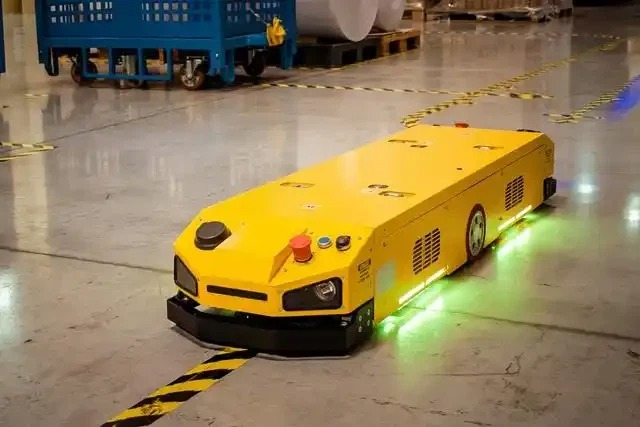
Step 1 — Clarify the Drive Architecture Before Evaluating Any Manufacturer
The first step is not researching suppliers. It is resolving the differential drive versus steering drive decision before any manufacturer conversation begins.
Differential drive achieves steering through the speed difference between left and right drive wheels. The principle is mechanically simple and historically dominant in automotive and Japanese-derived logistics automation. However, differential drive follows curved trajectories by definition. Lateral movement and omnidirectional motion remain outside its capability, regardless of control sophistication. Cumulative wheel speed errors also affect long-term positioning accuracy.
Steering drive integrates independent motors for traction and steering into a single mechatronic module. The wheel rotates to the required orientation before generating traction force. This produces direct, precise motion control. With two steering drive units installed, an AGV achieves full omnidirectional mobility — including lateral translation and in-place rotation. The three-point support structure inherent to steering drive configurations eliminates the need for additional suspension systems in most designs.
For applications involving narrow-aisle navigation, high-density warehouse layouts, or strict positioning requirements, steering drive removes motion constraints that differential systems cannot overcome. Manufacturer evaluation should only begin after this architectural decision is settled. A supplier whose core competence lies in differential drive may lack the engineering depth needed for steerable integration.
Step 2 — Match Load Capacity and Transmission Type to Application Requirements
Once the steerable architecture is confirmed, the next step maps load requirements to transmission type. Wheel diameter alone does not determine suitability. Torque curve, reduction ratio, and transmission architecture together define whether a drive wheel performs reliably under target operating conditions.
Plutools' Parallel Horizontal Drive Wheel with Steering covers wheel diameters from 167 mm to 300 mm. Load capacity ranges from 800 kg to 3,000 kg. Motor power spans 400W to 15 kW across voltage inputs from 12V to 96V. The parallel-axis transmission structure delivers smooth multi-directional operation with low noise. This series suits medium-load automation assembly lines, small mobile platforms, and flexible AGVs where multi-directional movement takes priority.
The Planetary Horizontal Drive Wheel with Steering addresses a broader load range — 600 kg to 20,000 kg across wheel diameters from 150 mm to 600 mm. Its planetary gear transmission achieves over 95% efficiency. Motor options and voltage compatibility mirror the parallel series. This configuration suits heavy industrial equipment, high-torque logistics handling, and forklift AGVs requiring precise control at high capacity.
The practical guide point: request published reduction ratio and output torque data from any candidate manufacturer. A supplier who provides detailed transmission specifications — not just maximum load figures — demonstrates engineering transparency that matters during integration.
Step 3 — Evaluate the Manufacturer's Factory Infrastructure Against Integration Requirements
Factory capability determines integration speed as much as product quality. Four specific checkpoints apply when auditing a Chinese steerable drive wheel manufacturer.
Precision machining capacity requires five-axis CNC machining centers and coordinate measuring machines achieving accuracy of plus or minus 0.01 mm. ISO 5 gear tooth standards support component service lives exceeding 20,000 hours under heavy-load conditions. Assembly discipline requires ISO 9001 procedures, laser coaxiality calibration for motor-reducer alignment, encoder signal coupling verification, and 100% online inspection on every unit — not batch sampling. A first-pass assembly success rate of 99.8% reflects process maturity. Testing completeness requires 12-stage validation: 72-hour full-load runs at 150% impact load, IP65 verification, temperature cycling between minus 30 and plus 70 degrees Celsius, and 1,000-hour salt spray exposure.
Beyond quality metrics, CAD file availability is a practical differentiator. Manufacturers who provide downloadable PDF drawings and 3D model files for steerable drive wheel series reduce integration time for engineering teams. Plutools' 10,000-square-meter facility with annual capacity of 100,000 units provides a useful scale benchmark when matching production volume to order requirements.
Step 4 — Verify Customization Depth Through Specific Scenario Requirements
Most manufacturers supply standard configurations competently. The critical evaluation step is testing customization capability against the hardest non-standard scenario in the target project — not the easiest.
Effective customization verification starts with the quality of engineering questions a manufacturer asks. A supplier who enquires about operating temperature range, contamination type, duty cycle, and installation height constraints before proposing a solution is operating from engineering depth. A supplier who offers a standard product immediately is not.
Low-temperature applications require material-level adaptation and adaptive control systems, not only standard compound changes. Explosion-proof configurations must follow verified international safety standards with integrated monitoring and early warning functions. High IP-rated variants need sealing validation data for specific particulate and moisture exposure levels. For compact under-ride AGV platforms — where traditional steering drive units historically failed to fit due to installation height constraints — purpose-engineered solutions such as the PLT120 horizontal steering drive wheel represent the category of product that a capable manufacturer can develop. This compact integrated module, designed specifically for low-height AGV platforms, demonstrates that meaningful customization addresses structural constraints, not just surface specifications.
With more than 500 customized products currently in active deployment, Plutools provides evidence that non-standard engineering requirements are handled at operational scale rather than as exceptional cases.
Step 5 — Assess Supply Chain Reliability as a Risk Management Criterion
Technical fit is necessary. Delivery consistency is what makes technical fit operational. Supply chain assessment represents the final but non-negotiable evaluation step — especially for international procurement teams sourcing from China.
Key component inventory turnover within seven days reduces project schedule risk when modified specifications require upstream adjustments. A global on-time delivery rate exceeding 99.2%, sustained through full-process MES digital management from raw material intake to final dispatch, provides a system-level reliability metric rather than a project-level claim. A supplier network of more than 100 core partners reduces single-source component risk for high-volume AGV projects.
Applying the Five-Step Framework — What the Evaluation Process Reveals
Each of the five steps addresses a distinct failure mode in manufacturer selection: wrong architecture choice, specification mismatch, undiscovered manufacturing deficiency, customization limits revealed during integration, and delivery failures during deployment. A manufacturer who satisfies all five criteria simultaneously has demonstrated technical depth, process maturity, customization capability, and supply reliability in combination — not in isolation. These capabilities reinforce each other. Precise machining enables customization at tolerance. Customization depth enables non-standard application coverage. Supply chain reliability makes both available on schedule.
For AGV developers and system integrators approaching steerable drive wheel sourcing, working through this framework before supplier engagement produces a materially different outcome. It shifts the initial conversation from price discussion to engineering specification — and that shift consistently reduces integration risk at the project level.
For technical specifications, product documentation, and engineering consultation, visit https://www.plutools.com/.
Shanghai Plutools Automation Corporation Limited
Shanghai Plutools Automation Corporation Limited
+ +86 15989586580
Eric.Tang@plutools.com
Visit us on social media:
LinkedIn
YouTube
X
Legal Disclaimer:
EIN Presswire provides this news content "as is" without warranty of any kind. We do not accept any responsibility or liability for the accuracy, content, images, videos, licenses, completeness, legality, or reliability of the information contained in this article. If you have any complaints or copyright issues related to this article, kindly contact the author above.
