

Mind the gap: credit dynamics in the euro area
26 January 2026
By Paola Di Casola, Caterina Mendicino, Giulio Nicoletti and Ana Skoblar
An effective transmission of monetary policy to credit is key for supporting investment and growth. This blog post examines the recent credit recovery, highlighting that it has been more gradual than in past episodes and explores the factors behind this sluggish recovery.
Since the ECB began cutting rates in June 2024, credit to the private non-financial sector has seen a gradual recovery. However, as this post shows, credit still remains below its estimated long-term trend, albeit by less than suggested by traditional frameworks. This indicates that, given prevailing macroeconomic conditions and the current phase of the policy cycle, the recovery is proceeding more gradually than in past episodes.
Credit dynamics in the euro area and historical regularities
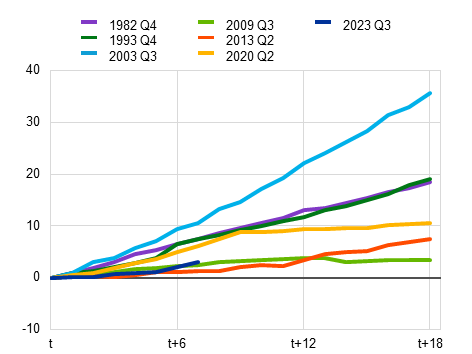
Current credit growth is weak by the standards of most previous recoveries. Our findings show that, especially in the first phase of the current monetary policy easing cycle, overall credit to the private non-financial sector grew at a rate that only slightly exceeded the rebounds seen in the wake of the global financial and sovereign debt crises (Chart 1). More specifically, all of the major sources of external finance for firms – including equity, trade credit and bank and non-bank lending – remain subdued by historical standards.
Chart 1
Euro area credit dynamics
Total credit to the private non-financial sector across economic recoveries |
|---|
(cumulative growth in annualised percentage changes) |
 |
Sources: ECB (QSA, BSI, FVC) and ECB calculations.
Notes: t denotes quarters since the trough in GDP growth. The latest observations are for the second quarter of 2025.
Measuring and assessing the credit gap
But how can we tell whether credit dynamics are keeping pace with the needs of the broader economy? The credit-to-GDP gap is one useful way of gauging whether the current credit growth is strong enough to sustain an economic recovery. It measures how current credit levels compare with their long-term trend relative to the size of the economy. A negative gap signals that firms are borrowing less than expected, given the current state of the economy. Similarly, a positive gap suggests they are borrowing more than usual.
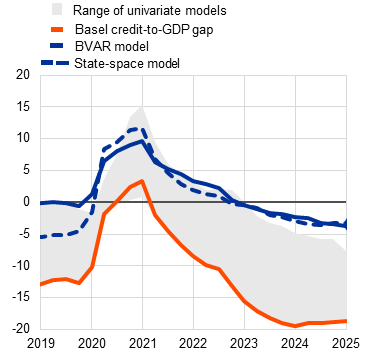
We estimated a variety of models, ranging from the standard Basel credit-to-GDP gap and other univariate statistical filtering techniques, to more sophisticated structural frameworks.[1] Across all model specifications, the gap of total credit to the private non-financial sector turned positive in 2021. However, it soon returned to negative territory and has not since recovered (Chart 2a).[2]
Chart 2
Credit-to-GDP gap
a) Total credit to the private non-financial sector |
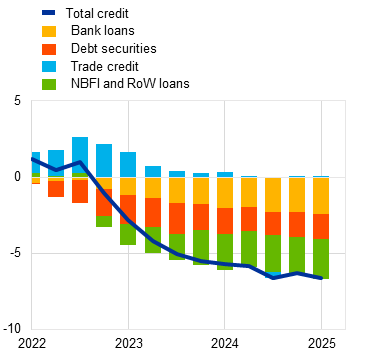
b) Total firm debt financing |
|---|---|
(percentages of annualised GDP) |
(percentage of annualised GDP) |
 |
 |
Sources: BIS, ECB (BSI, CSEC, QSA) and ECB computations.
Notes: In panel a), the shaded area reports the range of gap estimates across an ensemble of methods and definitions of total credit, using univariate filtering techniques. Univariate filters include the Hamilton filter, the HP filter and the five-year change. The BVAR model is an extension of Del Negro et al. (2017). The state-space model is an extension of Uribe (2022). In panel b), the credit-to-GDP gap is calculated using the extended version of the BVAR model by Del Negro et al. (2017). NBFI stands for non-bank financial intermediaries and RoW for rest of the world. The latest observations are for the first quarter of 2025.
Our preferred approach goes beyond the traditional filtering methods, drawing on a broader set of macroeconomic relationships so as to better capture the economy’s underlying (or “latent”) state.[3] This framework incorporates the drivers of both short and long-term credit dynamics, enabling a distinction to be drawn between the structural and cyclical forces shaping the current credit cycle. The resulting credit gap lies at the upper end of the range estimated using standard techniques, indicating a significantly smaller, yet still negative, current credit gap, as shown by the blue lines in Chart 2a.
In terms of the total credit to euro area firms, all of the major segments – except for trade credit – have contributed to the negative gap since rate hikes were paused in the third quarter of 2023 (Chart 2b). While the negative contribution of corporate bonds has gradually lessened over the most recent quarters, the contribution of non-bank financial intermediation has remained stable. The credit gap has also remained negative for household loans (relative to disposable income), albeit to a lesser extent. All of which suggests that the pass-through from policy rates to credit – and, ultimately, to the real economy – has been somewhat weaker than in the past.
What lies behind the persistent negative credit gap?
A negative credit gap can reflect both cyclical and structural factors. On the cyclical side, the lingering impact of the 2022–23 monetary tightening cycle is particularly relevant. Policy rates were raised rapidly and substantially. This led to a significant slowdown in credit growth, which has not yet fully reversed.[4] Higher risk perceptions, rising bank funding costs and tighter prudential requirements have further restrained lending. Meanwhile, direct lending from banks to non-bank financial institutions has risen significantly, partially substituting credit to firms, while non-bank financing has not expanded enough to make up the shortfall.[5] Additionally, elevated uncertainty surrounding economic policy – also stemming from trade policy tensions – may have weighed on credit dynamics during the current policy cycle.[6]
There is a persistent component in the 2022 upward shift in policy rates, with no return expected to the “low for long” zone. These persistently higher rates, compared with pre-pandemic levels, also matter, with rates on new lending remaining higher than those on existing loans. Moreover, the Bank Lending Survey indicators show that the cumulative net tightening has still to fully unwind. In other words, banks are reporting that their loan conditions and the overall demand for credit have not yet returned to pre-pandemic levels.
Structural factors also have the potential to reinforce these dynamics. First, shifts in consumption patterns away from durable goods and towards services could reduce the demand for credit. Second, firms’ increasing investment in intangible assets, such as software, relative to tangible capital, such as machinery, reduces the availability of collateral and may constrain access to bank financing. And lastly, demographic trends, leading to a fall in the demand for housing and durable goods, also weigh on the demand for credit.[7]
Looking Ahead
This blog post points to a persistent negative gap – albeit a smaller one than the traditional statistical models might suggest – between the current credit levels and those implied by historical patterns and the prevailing macroeconomic conditions. The future path of this credit-to-GDP gap remains uncertain given the various underlying cyclical and structural factors. The gap may gradually narrow, as the effects of the current monetary easing materialise, uncertainty recedes, and the financial system adapts to shifts in investment, consumption and demographic trends. Nonetheless, close monitoring of its underlying drivers remains essential, given the central role of credit in supporting investment and real economic activity.
The views expressed in each blog entry are those of the author(s) and do not necessarily represent the views of the European Central Bank and the Eurosystem.
Check out The ECB Blog and subscribe for future posts.
For topics relating to banking supervision, why not have a look at The Supervision Blog?
Legal Disclaimer:
EIN Presswire provides this news content "as is" without warranty of any kind. We do not accept any responsibility or liability for the accuracy, content, images, videos, licenses, completeness, legality, or reliability of the information contained in this article. If you have any complaints or copyright issues related to this article, kindly contact the author above.
